


New Build Planning Policy in Winchester (2026)
Winchester is a picturesque Hampshire market town with strict planning rules designed to protect its countryside character. If you’re a homeowner looking to build a new custom house, understanding the settlement boundaries and policies that govern development is essential. This guide explains what’s possible – and what isn’t, written by an Architect in Winchester.
Your first step – work out whether your proposal is going to be acceptable in principle.
The Winchester Settlement Hierarchy
Winchester’s planning system isn’t one-size-fits-all. Instead, the district is divided into different zones, each with its own rules for residential development. Your success depends entirely on where your site sits within this hierarchy and how you approach your application. This guide currently uses the 2013 adopted plan, but a new emerging plan is forthcoming.
Where Development Is Allowed
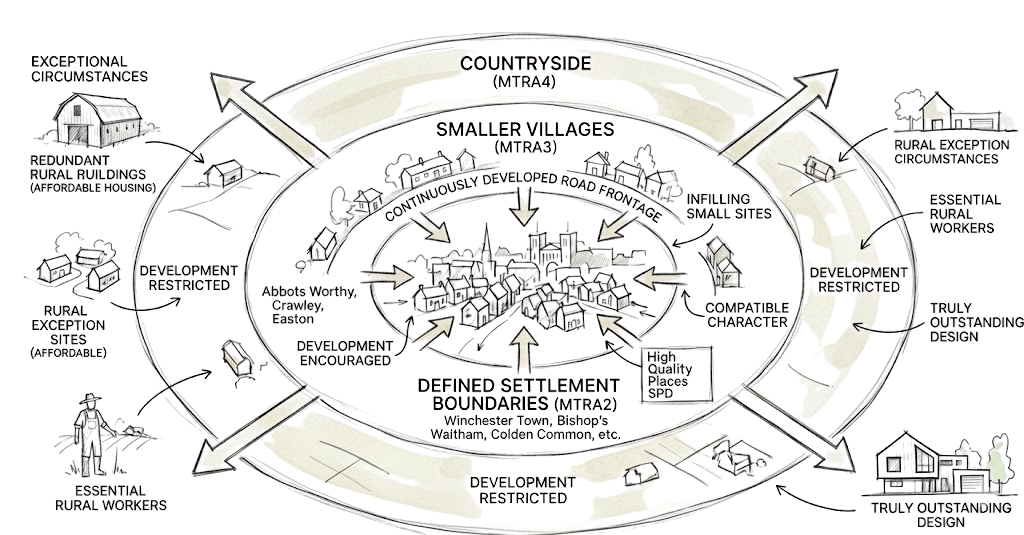
Policy MTRA2 notes that housing should be accommodated through development and redevelopment opportunities within existing settlement boundaries in the first instance. Sites outside settlement boundaries will only be permitted where, following an assessment of capacity within a built-up area, they are shown to be needed.
Winchester District has defined the “settlement boundaries” around its major towns and larger villages. These are the places where new residential development is actively encouraged within the defined boundaries of the following settlements, and redevelopment opportunities will be supported:
Bishop’s Waltham, Colden Common, Compton Down, Denmead, Hursley, Kings Worthy, Knowle, Littleton, Micheldever, Micheldever Station, New Alresford, Old Alresford, Otterbourne, South Wonston, Southdown, Southwick, Sparsholt, Sutton Scotney, Swanmore, Waltham Chase, Whiteley, Wickham, Winchester Town.
If your site falls within one of these areas and you meet the design standards set out in Winchester’s High Quality Places Supplementary Planning Document (SPD), permission for new residential development is established in principle. The Council wants development in these locations.
____
Where Development May Be Allowed
For smaller villages, MTRA3 also notes that where there are no clearly defined settlement boundaries, development and redevelopment that consist of infilling a small site within a continuously developed road frontage may be supported, where this would be of a form compatible with the character of the village, and not involve the loss of important gaps between developed areas:
Abbots Worthy, Avington, Beauworth, Beeches Hill, Bighton, Bishops Sutton, Bramdean, Chilcomb, ComptonStreet, Crawley, Curbridge, Curdridge, Durley, Durley Street, East Stratton, Easton, Exton, Gundleton, Headbourne Worthy (part), Hundred Acres, Itchen Stoke, Kilmeston, Lower Upham, Martyr Worthy, Meonstoke, New Cheriton/Hinton Marsh, Newtown, North Boarhunt, Northbrook, Northington and Swarraton, Itchen Abbas (part), Otterbourne Hill, Ovington, Owslebury, Shawford, Shedfield, Shirrell Heath, Soberton, Soberton Heath, Stoke Charity, Tichborne, Upham, Warnford, Wonston, Woodmancott.
_____
Where Development is Restricted
Everything outside settlements is classified as “countryside” under Policy MTRA4. New isolated dwellings will only likely be allowed in exceptional circumstances:
- Conversion of redundant rural buildings (barns, agricultural structures) to affordable housing.
- Affordable housing on rural exception sites with proven local need
- Homes for essential rural workers (farmers, forestry workers)
- Isolated dwellings of “truly outstanding” architectural design (Paragraph 80 of the National Planning Policy Framework)
Recent appeal decisions, such as APP/L1765/W/24/3350144 regarding Arnewood House, confirm that the Council prioritises the protection of the countryside even when a site contains existing built form. In that instance, the Inspector dismissed a proposal for a self-build dwelling, noting that the site’s location outside the settlement boundary outweighed the potential biodiversity enhancements and high-quality materials proposed.

The Replacement Dwelling Planning Route: The 25% Rule
For homeowners and developers looking to replace an existing dwelling in the countryside, Policy DM3 (and the emerging Policy H8) imposes a constraint known as the “25% rule”.
The policy identifies “smaller dwellings” as those with a gross external floorspace (GEA) of up to 120 square meters as of April 2017, or when originally constructed if later. If the property was >120sqm, than there is no limit, but the proposal will be tested alongside other planning policies, and good design practice.
The extension or replacement of these smaller dwellings is limited to an absolute increase of 25% over the original floorspace. This limitation is applied strictly and does not reset if a property is replaced or extended multiple times. Once the 25% limit has been reached, the Council will not generally permit any further enlargement.
The technical measurement of these dwellings follows specific guidelines:
- External Measurement: All calculations are based on gross external area (GEA).
- Habitable Space: Integral garages and roof spaces that form habitable rooms are included in the baseline.
- Excluded Outbuildings: Detached garages and non-habitable outbuildings are generally excluded, though their presence may be scrutinised for their impact on the landscape.
____
Case Law & Fallback Positions for Replacement Dwellings in Winchester
A planning fallback occurs when an applicant can demonstrate that a development, which might otherwise conflict with local policy, should be permitted because an alternative, equally or more harmful development could realistically be built using existing rights or permissions.
The Cartref Precedent (Bighton)
The appeal decision at Cartref, Bighton (Ref: 22/01333/FUL) represents a landmark case for replacement dwellings in the Winchester District. The original dwelling measured only 94.5 square meters, which under Policy DM3 would have restricted any replacement to approximately 118 square meters. However, the appellant proposed a replacement dwelling of 293 square meters – a nearly 200% increase over the original size.
The Inspector allowed the appeal based on a robust fallback strategy. The appellant had previously secured Prior Approval for a large extension and had established a Certificate of Lawfulness for other permitted development works. The Inspector applied a two-stage test:
- The “Real Prospect” Test: The appellant provided signed self-build forms and utility connection evidence, convincing the Inspector that there was a “greater than theoretical possibility” that the fallback scheme would be built if the application for the new house were refused.
- The “Comparative Harm” Test: The Inspector noted that while both the fallback and the proposed new build were the same size (293sqm), the fallback renovations would “consume the cottage-like character” of the original building. In contrast, the proposed new dwelling was of superior architectural quality, featuring a “barn-like” design that integrated better with the rural landscape.
This case demonstrates that a qualitative betterment (superior design) can outweigh a quantitative policy conflict (the 25% limit) if a viable fallback is established.
How Much Does a New Build Home Cost in Winchester
The build costs will vary, whether you’re looking to build a suburban infill property or a design-led paragraph 80 home. However, here are some benchmarking figures to help you with your planning:
____
Ecology: BNG, Nutrient Neutrality & Credits
Generally, every new dwelling must deliver a 10% measurable increase in biodiversity and maintain it for 30 years via legal agreements. This applies to nearly all new builds; however, self-builds are exempt if they meet certain criteria.
If looking for an exemption, the development must:
- consist of no more than 9 dwellings
- be on a site that has an area no larger than 0.5 hectares
- consist exclusively of dwellings that are self-build or custom housebuilding as defined in section 1(A1) of the Self-build and Custom Housebuilding Act 2015
You can check if you qualify as a self-build and custom housing here.
_____
How to Achieve 10% Biodiversity Net Gain
- On-site habitat creation – wildflower meadows, native hedgerows, bat boxes
- Off-site mitigation – purchase habitat units from established credit suppliers
Generally, it’s much cheaper and more favourable to complete most of your 10% Net Gain on-site, as Off-site mitigation can be expensive.
For your Planning Application, you’ll need an ecologist to:
- Survey the existing site (baseline biodiversity)
- Design habitat enhancements (gaining 10% measurable value)
- Commit to 30-year monitoring
Nutrient Neutrality: The Solent & Itchen Catchment
Residential projects in certain catchments must prove they don’t increase nitrogen/phosphorus pollution (which kills aquatic habitats). This is where new builds can become expensive. The costs for this vary, depending on size of property, on-site mitigation and your local waste treatment works however the following figures should help manage your expectations and what to expect:
Our Process for Building a Bespoke Home
Here’s a step-by-step guide in terms of how we generally approach new build & bespoke homes at ZAHRADA:
- Planning Principle: Identify whether what you’re looking to do will be acceptable in principle. Outline a planning strategy, and whether we need to prepare any fallback positions together.
- Nutrient Neutrality: Establish which catchment your site drains to. Get a quote for credit cost. Don’t proceed without this answer, as credits can be sparse and cost £25,000+ per home. We’ll help you budget this within your overall project cost plan (including professional and survey fees).
- Complete a High Quality Design: Use the High Quality Places SPD, and your applicable village and neighbourhood design statements to document the neighbouring area, and prepare a design narrative to how your design fits and reflects its surroundings. Your proposal must respect local, established and distinctive character. This doesn’t mean your design can’t be contemporary, but it must be contextual. This is when you’ll also need to complete any early survey work which we can organise on your behalf.
- Pre-Application Advice: Depending on how contentious your proposals are, we’d suggest early engagement with Winchester City Council.
- Develop your Design: Refine your plans based on the Council Feedback, alongside any final tweaks you want to make to the design. If going for a Paragraph 80 Home, you may wish to consider a Design Review Panel Assessment before finalising anything.
- Submit Your Planning Application: Submit. Expect 8-13 weeks for a decision. More often than not, your application will take a little longer, depending on the complexities of your project.
____
Total timeline:
- 6-9 months from concept to approval for a straightforward new build inside a settlement boundary.
- 12-18 months if you’re in the countryside or involved in a fallback strategy.
- 24-36 months if this is a Paragraph 80 home, involving multiple stages of design refinement, additional surveys and a possible appeal process.
____
Your Next Steps
Start with a pre-application consultation with Winchester City Council’s planning team. It costs little, often takes 4-6 weeks, and will clarify whether your ambitions are realistic. If the feedback is positive, you can move forward with confidence. If it’s negative, you’ll save months of wasted effort and expense.
If you’d like a Local Architect in Winchester to help you with your project, reach out to Tim at ZAHRADA to discuss your project.
This guide is for informational purposes and does not constitute planning or legal advice. Planning decisions are made on a case-by-case basis. Always consult a qualified planning consultant or solicitor before submitting a planning application or entering into a land purchase agreement.
About the Author
Email: design@zahrada.co.uk
Phone: +44 01962 453990
ZAHRADA is led by Tim Willment, an ARB-registered Architect. He is supported by his wife Zofia, an Architectural & BIID-registered Interior Designer.
We’ve built a design practice that is small, intimate and approachable. We have a particular fondness for breathing new life into old and forgotten spaces, giving them a “glow up” that respects their history while adding a fresh, modern twist.